Five Laws of S.R. Ranganathan in the Web age
1. Links are for use the very essence of hypertext;
2. Every surfer his or her link the rich diversity of links across topics and genres;
3. Every link its surfer
4. Save the time of the surfer visualizing web clusters and small-world shortcuts;
5. The Web is a growing organism
By - Lennart Bjrneborn., PhD in webometrics-Royal School of Library and Information Science


Europe's digital library taking shape
At least 6 million books, documents and other cultural works will be made available online over the next five years under a planned European Digital Library. The European Commission on Thursday released more details about its plans to finance a series of "digitization centers" across the continent and create a framework for protecting intellectual property rights. The centers will house the skills and expertise "needed to achieve excellence for digitization and preservation processes," the EC said. Viviane Reding, the EC's information society and media commissioner, said in a statement Thursday that technology will "enable you to tap into Europe's collective memory with a click of your mouse." People will be able to search the collections of libraries, archives and museums through a single, multilingual entry point, which will take the form of a Web portal. Two million books, films, photographs, manuscripts and other works are expected to become accessible through the library by 2008, rising to 6 million by 2010. The EC said the final figure would be much higher as "every library, archive and museum in Europe will be able to link its digital content to the European Digital Library." The Commission noted that Google's digital library project had "triggered a reflection" on how to deal with Europe's cultural heritage in the digital age. "It is also interesting in that it highlights the possibilities for public/private initiatives in this area. Public/private partnerships or sponsoring by private companies will accelerate digitization," the Commission said. "Given the budgetary constraints on many cultural institutions, initiatives involving the private sector can be a useful means to complement public funding." Steve Ranger of Silicon.com reported from London.
First things first
First things firstHere starts the introspection. What do you really want in life ? How can you manage time ? How efficiently can we handle situations without much tension ? How can we effectively balance family life and professional life ? Plan the action strategy in mind. Make a plan in written format How can we plan and stack our time right from morning ? How much efficiently can we idiolize balancing time and work, right from the time we get up and again go back to rest ? Think… Start the day with a great note of positive energy.. Tell yourself that you are going to give your best today in all aspects.. Remind yourself of the all tasks and activities to be done on a particular day.. Stay positive and never give up. Visualise what do you really want in life ? Work your plan and Plan your work to success. Patience and perseverance is the key for everything... Never postpone things and quit things...“A quitter always feels bitter”. Quitting job today doesn’t mean ending, it means facing it again. You quit a job at best hour to meet the same during future at the worst hour. So what do you learn from this ? Useful times can be measured. And wasteful moments can be realized only after its end. Be positive always and strengthen your mind thru prayers and meditation. Surrender yourself truly to the guru and wait patiently for the right direction which will be shown by the guru.. To put in a nutshell it is just “Landing in the path of excellence through hard work, grace factor and other efforts protected by prayers”. For all these things, mindset is the main trum card..I hope we accept the reality.. Have a smiling face to accept problems and see to that the solution is very close to it which we fail to identify it always. We always blame it on the fate. Of course, we can rewrite it if we have proper sraddha and devotion to god. Try practicing these things by devoting time for talking to your own self, where you analyse more and increase the feeling of acceptance. Auto suggestions are the key for improving our self. Be Positive and never give up. Let us love whatever we are doing daily and be true to our self.
ONE PARAGRAPH THAT EXPLAINS LIFE!
Arthur Ashe, the legendary Wimbledon player was dying of AIDS which he got due to infected blood he received during a heart surgery in 1983. From world over, he received letters from his fans, one of which conveyed: "Why does GOD have to select you for such a bad disease"? To this Arthur Ashe replied: The world over -- 5 crore children start playing tennis, 50 lakh learn to play tennis, 5 lakh learn professional tennis, 50,000 come to the circuit, 5000 reach the grand slam, 50 reach Wimbledon, 4 to semi final, 2 to the finals, When I was holding a cup I never asked GOD "Why me?". And today in pain I should not be asking GOD "Why me?" Happiness keeps u Sweet, Trials keep u Strong, Sorrow keeps u Human,Failure Keeps u Humble, Success keeps u Glowing, But only God Keeps u Going..... Keep Going.....
Google Merges Instant Messenger With E- mail
Google is integrating its popular e-mail service with its instant messaging (IM), allowing users to chat and send e-mails from the same web browser window. The new facility will be visible to existing subscribers from within Google's Gmail browser window. Full Details:www.techtree.com/techtree/jsp/article.jsp?article_id=71207&cat_id=643
Listen to Dr. Ranganathan.
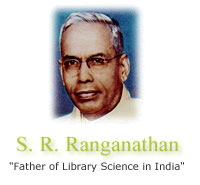
This was on cassette in the collection of the Faculty of Information Studies at the University of Toronto. It's a 1964 recording of the great librarian S.R. Ranganathan giving a fifteen-minute talk about his connections with Melvil Dewey. They never met, but they did correspond, and Ranganathan recounts that and four other anecdotes, including an amusing one he was told about Dewey conniving so that his female employees could enter his library by the front door and not the fire escape. (Ranganathan jokingly relates the number five to his Colon Classification.) S.R. Ranganathan's Monologue on Melvil Dewey (6 MB MP3). A warning about the audio quality: the first 1m56s were damaged on the cassette, and Ranganathan's voice is very faint and almost overwhelmed by hiss. it's hard to hear. After that, the rest of the speech is of much better quality.
What Open Access is?
What Open Access is
The Open Access research literature is composed of free, online copies of peer-reviewed journal articles and conference papers as well as technical reports, theses and working papers. In most cases there are no licensing restrictions on their use by readers. They can therefore be used freely for research, teaching and other purposes.
What Open Access is not
There are various misunderstandings about Open Access. It is not self-publishing, nor a way to bypass peer-review and publication, nor is it a kind of second-class, cut-price publishing route. It is simply a means to make research results freely available online to the whole research community.
How is Open Access provided?
Open Access can be provided by various means. A researcher can place a copy of each article in an Open Access archive or repository or can publish articles in Open Access journals. In addition, a researcher may place a copy of each article on a personal or departmental website. Whilst all three routes to Open Access ensure that far more users can access such articles than if they were hidden away in subscription-based journals, the first two constitute much more systematic and organised approaches than the third and maximise the chance of other researchers locating and reading articles. Open Access archives or repositories are digital collections of research articles that have been placed there by their authors. In the case of journal articles this may be done either before (preprints) or after publication (postprints). This is known as ‘self-archiving’. These repositories expose the metadata of each article (the title, authors, and other bibliographic details) in a format compliant with the Open Archives Initiative Protocol for Metadata Harvesting (OAIPMH). To access the contents of these archives, you can use Google or one of the specialised search engines for a more focused and efficient search. The latter systematically harvest the contents of the archives worldwide, forming a database of current global research. Open Access repositories may be multidisciplinary and located in universities or other research-based institutions, or they may be centralised and subject-based, such as the one covering certain areas of physics and related disciplines, called arXiv. By the beginning of 2005, there were almost 40 Open Access archives in the UK, and more universities and research institutes are planning to launch their own. A list of Open Access archives in the UK is maintained by the Eprints.org site at Southampton University. If your institution does not have an archive, extensive information on how to set one up can be found on that website. Self-archiving is an international movement that is developing fast, and some grant funders are also now planning central archives to house the articles of their grant-holders. If you are concerned that your journal’s publisher may have copyright restrictions that would prevent you from selfarchiving your articles, this will in most instances not be the case. Current publisher policies on self-archiving and copyright are detailed on the SHERPA project website at Nottingham University. Open Access journals are peer-reviewed journals whose articles may be accessed online by anyone without charge. In many cases they may also be published in print. Some, mainly those published from a university department or with substantial subsidy, make no author or page charges. Others levy a charge for publishing an article, turning on its head the traditional model where a library pays for access to the contents of a journal through a subscription. This charge may be paid by the author(s) but in most cases it is financed by a research grant or institutional funds. Your institution may already have taken the decision to pay for Open Access articles to be published, or your grant-awarding body may have adopted this as one of its policies. A list of grant awarding bodies that explicitly permit funds to be used for this purpose is maintained on the BioMed Central website. BioMed Central is a well-known Open Access publisher with over 100 journals in its portfolio. Other examples are the journals from the Public Library of Science, such as PLoS Medicine, PLoS Biology. In the case of an author’s financial hardship, BioMed Central, PLoS and other Open Access journal publishers will waive the publication fee. Fees levied by Open Access journals vary quite markedly but, as a guideline, BioMed Central charges £330 per article for most of its journals, and PLoS charges US$1,500 (approx. £800). In 2003 JISC secured a deal with BioMed Central on behalf of UK institutions to waive author fees for over 90 biomedical journals. A comprehensive list of Open Access journals in all subject areas is maintained by the University of Lund. In early 2005 this list contained over 1,400 journals. Many of these Open Access journals have impact factors and are indexed by the Institute for Scientific Information for its Web of Knowledge/ Web of Science service. At June 2004, 239 Open Access journals were in this category. Another form of Open Access is found in ‘hybrid’ journals: these are publications that will make an article accessible to everyone online without charge if the author opts to pay for publication. An example of a hybrid journal is the Proceedings of the National Academy of Sciences, which will make an article Open Access for a fee of US$1,000.
Why should authors provide Open Access to their work?
There is accumulating evidence that shows that research articles that have been self-archived are cited more often than those that have not. Across most subject areas there is at least a twofold increase in citation rate. In some subject areas it is even higher. This form of Open Access means that research has much more impact than before. Moreover, the research cycle – where work is published, read, cited and then built upon by other researchers – is enhanced and accelerated when results are available on an Open Access basis. Would you not prefer to be able to access all the articles you need
The Open Access research literature is composed of free, online copies of peer-reviewed journal articles and conference papers as well as technical reports, theses and working papers. In most cases there are no licensing restrictions on their use by readers. They can therefore be used freely for research, teaching and other purposes.
What Open Access is not
There are various misunderstandings about Open Access. It is not self-publishing, nor a way to bypass peer-review and publication, nor is it a kind of second-class, cut-price publishing route. It is simply a means to make research results freely available online to the whole research community.
How is Open Access provided?
Open Access can be provided by various means. A researcher can place a copy of each article in an Open Access archive or repository or can publish articles in Open Access journals. In addition, a researcher may place a copy of each article on a personal or departmental website. Whilst all three routes to Open Access ensure that far more users can access such articles than if they were hidden away in subscription-based journals, the first two constitute much more systematic and organised approaches than the third and maximise the chance of other researchers locating and reading articles. Open Access archives or repositories are digital collections of research articles that have been placed there by their authors. In the case of journal articles this may be done either before (preprints) or after publication (postprints). This is known as ‘self-archiving’. These repositories expose the metadata of each article (the title, authors, and other bibliographic details) in a format compliant with the Open Archives Initiative Protocol for Metadata Harvesting (OAIPMH). To access the contents of these archives, you can use Google or one of the specialised search engines for a more focused and efficient search. The latter systematically harvest the contents of the archives worldwide, forming a database of current global research. Open Access repositories may be multidisciplinary and located in universities or other research-based institutions, or they may be centralised and subject-based, such as the one covering certain areas of physics and related disciplines, called arXiv. By the beginning of 2005, there were almost 40 Open Access archives in the UK, and more universities and research institutes are planning to launch their own. A list of Open Access archives in the UK is maintained by the Eprints.org site at Southampton University. If your institution does not have an archive, extensive information on how to set one up can be found on that website. Self-archiving is an international movement that is developing fast, and some grant funders are also now planning central archives to house the articles of their grant-holders. If you are concerned that your journal’s publisher may have copyright restrictions that would prevent you from selfarchiving your articles, this will in most instances not be the case. Current publisher policies on self-archiving and copyright are detailed on the SHERPA project website at Nottingham University. Open Access journals are peer-reviewed journals whose articles may be accessed online by anyone without charge. In many cases they may also be published in print. Some, mainly those published from a university department or with substantial subsidy, make no author or page charges. Others levy a charge for publishing an article, turning on its head the traditional model where a library pays for access to the contents of a journal through a subscription. This charge may be paid by the author(s) but in most cases it is financed by a research grant or institutional funds. Your institution may already have taken the decision to pay for Open Access articles to be published, or your grant-awarding body may have adopted this as one of its policies. A list of grant awarding bodies that explicitly permit funds to be used for this purpose is maintained on the BioMed Central website. BioMed Central is a well-known Open Access publisher with over 100 journals in its portfolio. Other examples are the journals from the Public Library of Science, such as PLoS Medicine, PLoS Biology. In the case of an author’s financial hardship, BioMed Central, PLoS and other Open Access journal publishers will waive the publication fee. Fees levied by Open Access journals vary quite markedly but, as a guideline, BioMed Central charges £330 per article for most of its journals, and PLoS charges US$1,500 (approx. £800). In 2003 JISC secured a deal with BioMed Central on behalf of UK institutions to waive author fees for over 90 biomedical journals. A comprehensive list of Open Access journals in all subject areas is maintained by the University of Lund. In early 2005 this list contained over 1,400 journals. Many of these Open Access journals have impact factors and are indexed by the Institute for Scientific Information for its Web of Knowledge/ Web of Science service. At June 2004, 239 Open Access journals were in this category. Another form of Open Access is found in ‘hybrid’ journals: these are publications that will make an article accessible to everyone online without charge if the author opts to pay for publication. An example of a hybrid journal is the Proceedings of the National Academy of Sciences, which will make an article Open Access for a fee of US$1,000.
Why should authors provide Open Access to their work?
There is accumulating evidence that shows that research articles that have been self-archived are cited more often than those that have not. Across most subject areas there is at least a twofold increase in citation rate. In some subject areas it is even higher. This form of Open Access means that research has much more impact than before. Moreover, the research cycle – where work is published, read, cited and then built upon by other researchers – is enhanced and accelerated when results are available on an Open Access basis. Would you not prefer to be able to access all the articles you need
Subscribe to:
Posts (Atom)